
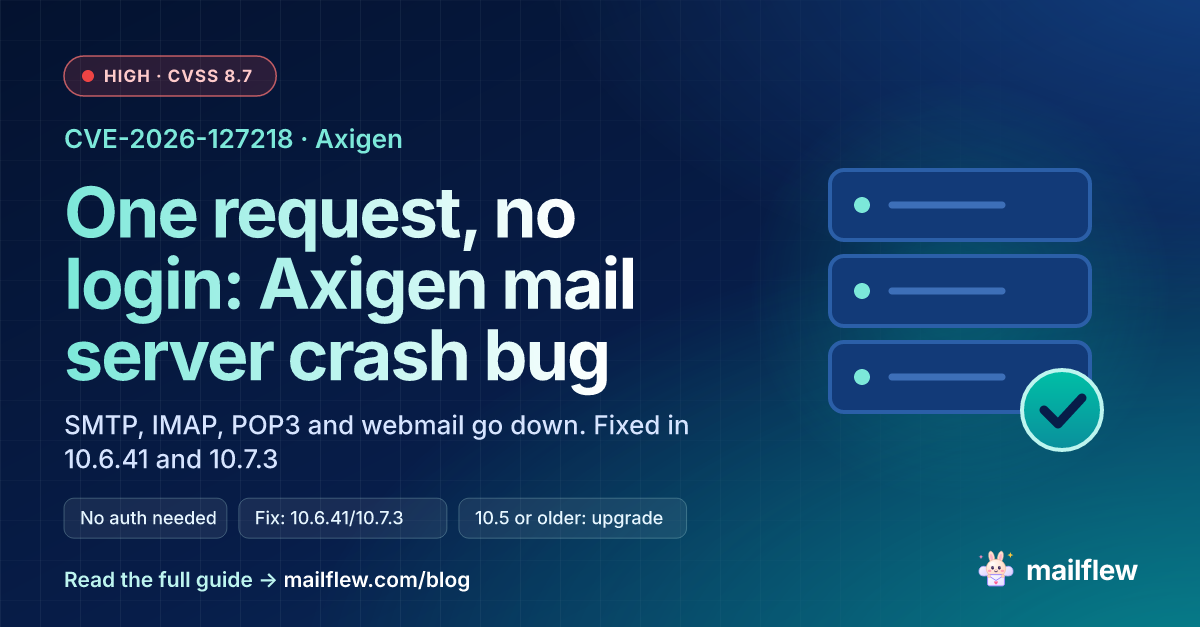
Axigen has fixed a vulnerability, tracked as CVE-2026-127218, that lets an attacker crash an Axigen Mail Server with a single web request, without logging in. When the server process goes down, it takes SMTP, IMAP, POP3 and webmail with it, and the attacker can keep it down by repeating the request.
If you or your clients run Axigen, and WebMail or WebAdmin can be reached from the internet, plan the upgrade now. The fixed versions are 10.6.41 and 10.7.3. Older branches have no patch and need to move to 10.6 or 10.7.
What the flaw is
According to the VulnCheck advisory, WebAdmin and WebMail check query parameter and cookie values with a recursive regular expression engine before the user authenticates. A regular expression is a text-matching pattern; a recursive engine calls itself again for each step of the match. Send a value a few thousand characters long and the recursion exhausts the stack of the worker thread, and the whole server process crashes.
The Axigen advisory (KB 413) adds that only a narrow range of lengths triggers the crash, because longer values hit the request size limit. The fix replaces the regular expression with a linear, recursion-free check.
Key details from the CVE record:
| Item | Value |
|---|---|
| CVE | CVE-2026-127218 |
| Weakness | CWE-674, uncontrolled recursion |
| CVSS v4.0 | 8.7 High |
| CVSS v3.1 | 7.5 High |
| Login needed | No |
| Impact | Availability (server crash) |
| Published | 16 November 2026 |
| Fixed in | 10.6.41 and 10.7.3 |
This is a denial-of-service bug. The CVSS vectors rate confidentiality and integrity impact as none: it does not let an attacker read mail or take over the server. But for a mail server, losing all mail flow on demand is serious, and the attack is cheap.
Who is affected
Axigen lists these affected versions:
- 10.3.3.67 and later 10.3.3.x
- 10.4.42 and later 10.4.x
- 10.5.29 up to 10.5.68
- 10.6.x up to 10.6.40
- 10.7.0 up to 10.7.2
The CVE record words the 10.5 range as "10.5.29 through 10.5.x", so treat every 10.5 release from 10.5.29 onward as affected. The attacker needs network access to a WebAdmin or WebMail listener. A server whose web interfaces can only be reached from an internal network is much harder to attack, but anyone inside that network can still trigger the crash.
A second, similar bug fixed in October
This is the second pre-authentication crash bug in Axigen in about a month. CVE-2026-119762 (KB 412) let an attacker crash the server with a single deeply nested SOAP/XML or JSON request to WebMail, WebAdmin or the WebMail Proxy used in clustered setups. It has the same scores (CVSS v4.0 8.7, v3.1 7.5) and was fixed in 10.5.69, 10.6.40 and 10.7.2, released on 19 October 2026.
If you patched for that one and stopped at 10.6.40 or 10.7.2, you are still exposed to CVE-2026-127218. The newer releases also add extra hardening: the 10.6.41 release notes list "Reject SOAP and JSON requests with bodies that exceed the nesting limit" alongside the fix for CVE-2026-127218.
How to check
- Find your version. Check the Axigen version shown in WebAdmin and compare it with the list above.
- Find your exposure. List which WebMail, WebAdmin and WebMail Proxy listeners are reachable from the internet. From an outside network, a simple request shows whether a web interface answers:
Repeat for each hostname and port your listeners use.curl -I https://mail.example.com/ - Look for signs of trouble. Unexplained crashes or restarts of the Axigen process since early November are worth investigating, especially if they line up with unusual web requests in your logs.
How to fix it
Upgrade
Axigen's advice in KB 413 is simply "Update now from your WebAdmin." Move to:
- 10.6.41 or later on the 10.6 branch (release notes), or
- 10.7.3 or later on the 10.7 branch (release notes). The 10.7.3 page notes that 10.7.4 is now the latest 10.7 release.
Both 10.6.41 and 10.7.3 were released on 10 November 2026 and also include the October fix for CVE-2026-119762.
Running 10.3, 10.4 or 10.5? There is no fix for CVE-2026-127218 on those branches. VulnCheck says users should update to a fixed 10.6 or 10.7 version. Treat this as a version upgrade project rather than a routine patch: test it on a copy first, take a full backup, and schedule a maintenance window.
Reduce exposure until you can upgrade
Axigen does not publish a workaround. Because the attack needs access to a web listener, the sensible interim step is to limit who can reach those listeners:
- Restrict WebAdmin to a management network or VPN. It rarely needs to face the internet.
- If WebMail must stay public, put it behind a reverse proxy or firewall that can limit request sizes and rates, as OpenCVE's guidance for the related bug suggests.
- Keep monitoring that restarts the service and alerts you if the process stops.
These steps reduce risk but are not a fix. Upgrade as soon as you can.
Is it being exploited?
We found no public reports of attacks using CVE-2026-127218. The related CVE-2026-119762 is not in CISA's Known Exploited Vulnerabilities list, and CISA's assessment, shown on OpenCVE, records no exploitation but rates it as automatable. That means an attacker could script it easily. Crash bugs that need one request and no login tend to be picked up quickly once details are public, and the VulnCheck advisory describes the trigger clearly.
What this means for your organisation
Two pre-authentication crash bugs in a month point to the same lesson: the web interfaces of a mail server are its most exposed surface. Every service on the box, including inbound and outbound SMTP, shares the fate of the web code.
For MSPs managing several Axigen tenants, this is a good moment to inventory versions across clients, especially any still on 10.5 or older branches. Those now need a planned upgrade to stay supported for security fixes. For business owners, the practical question to ask your provider is simple: which Axigen version are we on, and is WebAdmin reachable from the internet?
Actions
- Check your Axigen version against the affected ranges today.
- Upgrade to 10.6.41+ or 10.7.3+ (10.7.4 is the latest 10.7 release).
- Plan an upgrade to 10.6 or 10.7 if you run 10.3, 10.4 or 10.5.
- Restrict WebAdmin to trusted networks and limit WebMail exposure until patched.
- Confirm you also have the October fix for CVE-2026-119762.
Frequently asked questions
What is CVE-2026-127218?
It is a denial-of-service flaw in Axigen Mail Server. An unauthenticated attacker can crash the server with one web request to WebMail or WebAdmin, stopping SMTP, IMAP, POP3 and webmail.
Which Axigen versions fix CVE-2026-127218?
Axigen 10.6.41 and 10.7.3, both released on 10 November 2026. There is no fix on the 10.3, 10.4 or 10.5 branches, so those servers need to move to 10.6 or 10.7.
Can CVE-2026-127218 be used to read email?
No. Its CVSS scores rate only availability impact, so it crashes the server but does not expose data or give control of it.
Is there a workaround if I cannot upgrade Axigen yet?
Axigen does not publish one. Restricting network access to the WebAdmin and WebMail listeners reduces the risk until you can upgrade.
Sources
- Axigen KB 413: DoS via oversized HTTP request parameters
- VulnCheck: Axigen unauthenticated DoS via regex recursion
- CVE record: CVE-2026-127218
- NVD: CVE-2026-127218
- Axigen 10.6.41 release notes
- Axigen 10.7.3 release notes
- Axigen KB 412: CVE-2026-119762 nested request DoS
- OpenCVE: CVE-2026-119762